
Photo credit: Helen Walter
Who are the Woongarra Coast Turtle Volunteers?
The Woongarra Coast Turtle Volunteers (WCTV) are a dedicated group of more than 100 volunteers who play an important role in monitoring and protecting nesting sea turtles along the Woongarra Coast, from Oaks Beach through to Woodgate. Through nightly patrols, nest monitoring and data collection provides valuable information that supports ongoing turtle conservation and research efforts.
Turtle monitoring along the Woongarra Coast began at Oaks Beach during the 2003/04 nesting season under the guidance of Queensland Turtle Research and Dr Col Limpus. What started with just 3 volunteers has grown significantly over the past two decades. In the 2009/10 season, a separate volunteer group commenced patrols between Neilson Park and Archies Beach, later becoming known as the Bargara Beach Turtle Volunteers. Over time, additional volunteer groups from Elliot Heads, Innes Park, and Woodgate joined together eventually forming Woongarra Coast Turtle Volunteers Inc seen today.
Life on Turtle Patrol
Today, turtle volunteers patrol beaches throughout the turtle nesting season, from sunset through to sunrise. For many, the experience is about more than conservation alone. Volunteers return year after year, driven by a shared passion for protecting turtles, the friendships formed through patrols, and the unique experiences that come with spending countless hours on the beach beneath moonlit skies and early morning sunrises. Encounters with wildlife, bioluminescence in the waves, and the quiet anticipation of discovering turtle tracks all contribute to the unforgettable experience of turtle monitoring.
When a nesting turtle is encountered, volunteers carefully monitor the nesting process before recording important scientific data, including flipper tag details, carapace measurements, and the turtle’s overall condition. These moments often attract curious families, children, and visitors eager to witness a turtle nesting event firsthand. Volunteers enthusiastically share their knowledge and help educate the community about the importance of marine turtle conservation.
Approximately 60 days later, hatchlings begin emerging from their nests and make their journey to the ocean. For volunteers and members of the public alike, witnessing hatchlings scurrying down the beach is one of the most rewarding parts of the season. With only an estimated 1 in 1,000 hatchlings surviving to adulthood, volunteers remain deeply committed to protecting these valuable marine animals and improving their chances of survival.
Conservation in Action
Throughout the years, volunteers have experienced many memorable and emotional moments while on patrol. During a severe weather event in early 2025, the volunteers discovered an exposed nest on the side of a steep sand bank at Kelly’s Beach, the nest contained live hatchlings that had already begun to ‘pip’ (the stage where hatchlings begin emerging from their eggs). Volunteers carefully relocated and reburied the eggs in a newly constructed chamber, resulting in the successful hatching of 115 turtles just days later.

Photo credit: Diane Anderson
Another unforgettable experience involved helping a disabled teenage girl fulfil her dream of seeing a nesting turtle up close, while volunteers also continue to be inspired by the resilience of the turtle themselves. During one recent nesting event, a Loggerhead turtle successfully laid 151 eggs despite carrying a large, healed shark bite of her carapace.
Many WCTV members are also trained stranding responders, assisting injured turtles along the coastline. While some strandings occur naturally, many turtles continue to be impacted by human-related threats such as plastic pollution, entanglement, and boat strike injuries. According to the International Union for Conservation Nature (IUCN), South Pacific loggerhead turtles are listed as critically endangered, highlighting the importance of ongoing conservation efforts and community involvement.
How You Can Help Protect Turtles
Community support plays a critical role in helping protect turtles and their nesting habitat. Simple actions such as reducing plastic waste, keeping beaches clean, minimising artificial light near nesting beaches, and keeping dogs on leashes can all make a difference.
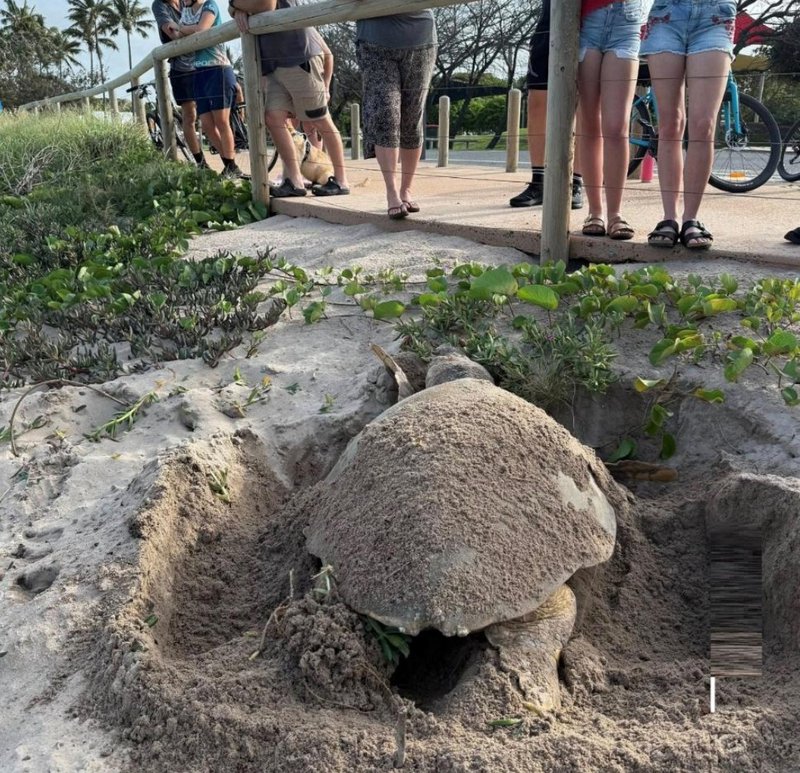
Photo credit: Pam Riik
If you encounter a nesting turtle, remain behind the turtle, stay still, and avoid using torches or phone lights. Human movement and artificial light can frighten a turtle, causing her to return to the water before laying her eggs. If a volunteer is not present, please call the Turtle Hotline.
Turtle Hotline: 0491 140 198
Residents can also support turtle conservation by participating in local beach clean-ups, dune revegetation activities, and citizen science projects.
For WCTV, the long nights, lack of sleep, and tired feet are far outweighed by the privilege of witnessing one of nature's most remarkable events. Their ongoing dedication helps ensure future generations will continue to experience the wonder of marine turtles along the Woongarra Coast for many years to come.
"Images were acquired whilst conducting authorised monitoring activities as a citizen scientist for the Department of Environment Tourism Science and Innovation, under permits issued to the Queensland Turtle Conservation Project."