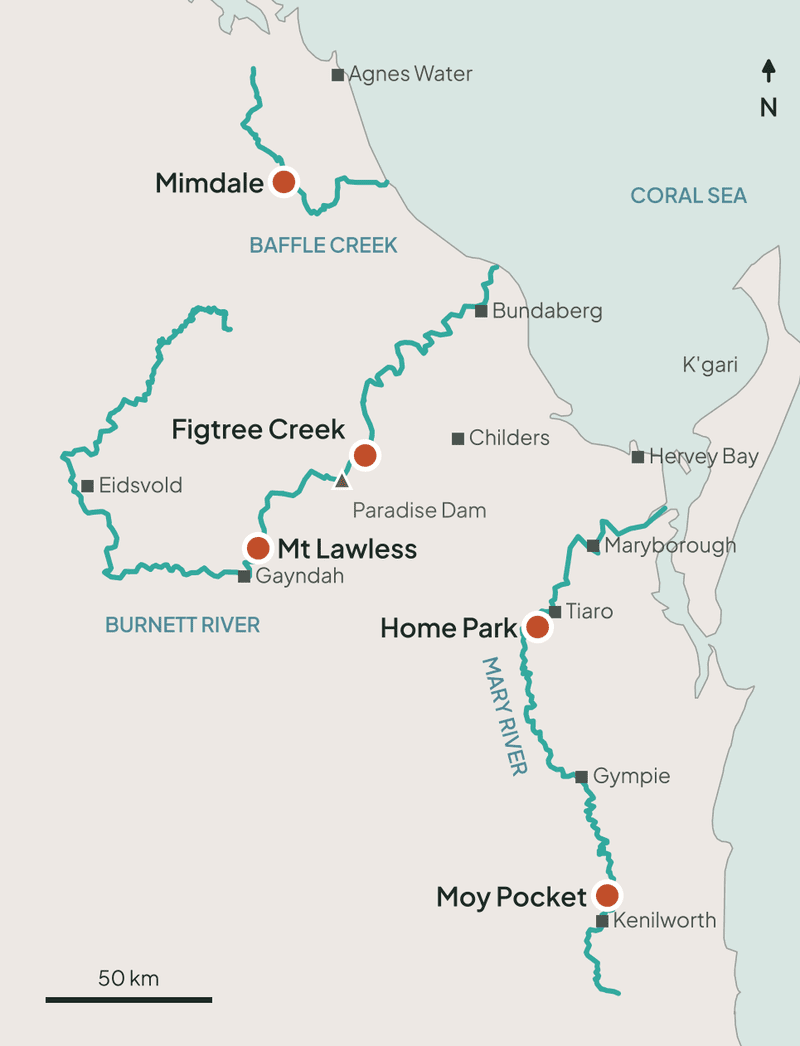
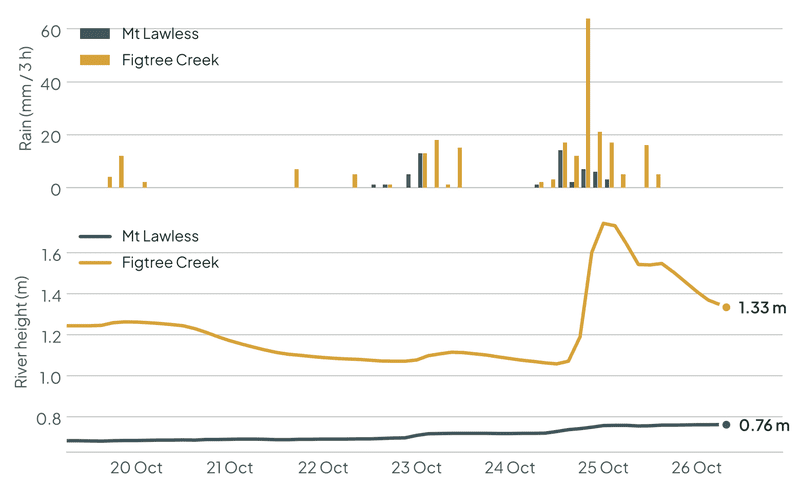
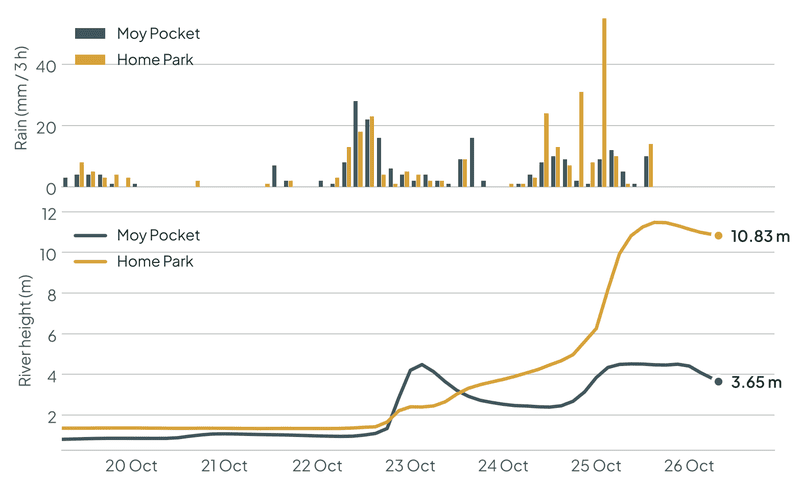
It's been a big few days of somewhat unseasonal rain on our rivers. What's usually short sharp storms set in for sustained light to medium rain for over a week. The rain set in on Thursday 22 October and didn't really let up until Sunday. Home Park on the lower Mary got 252 mm over those four days, Figtree Creek on the Burnett 215 mm, Moy Pocket on the upper Mary 195 mm and Mimdale on Baffle Creek 135 mm. Mt Lawless, up above Paradise Dam, only got53 mm.
The rivers all reacted differently. The lower Mary at Home Park went from 1.3 m to 11.5 m, peaking on Sunday evening. Moy Pocket hit 4.5 m twice, on Friday and again on Sunday. Figtree had a short, sharp pulse and is already dropping. And Baffle Creek, which wasn't even flowing a week ago, was still climbing at 7 am this morning.
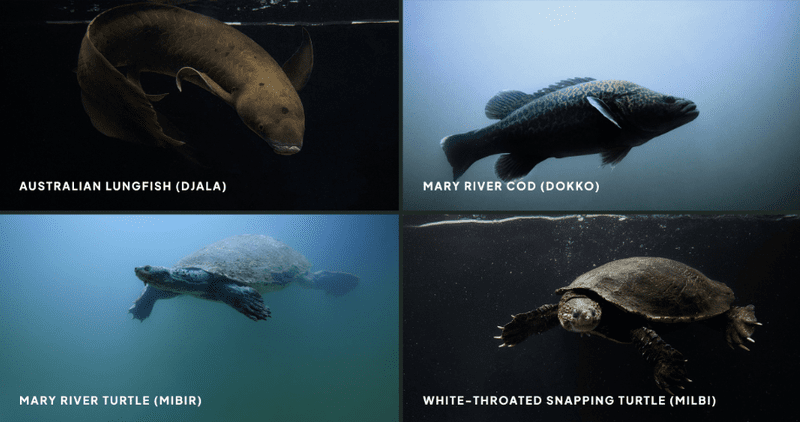
So how are our Big Four going? That's the Australian lungfish (Djala), Mary River cod (Dokko), Mary River turtle (Mibir) and white-throated snapping turtle (Milbi). The Burnett has some good news. The Mary and Baffle, not so much. Here's how it looks river by river.
Australian lungfish (Djala)
Djala are right in the middle of spawning season. They're after small rises in flow, water between 18 and 28 °C, and shallow beds of water plants to lay their eggs on. Eggs take up to a month to hatch, so what the river does in the weeks after spawning matters just as much as the spawning itself.
Burnett River
This is our silver lining. Saturday's 119 mm around Figtree pushed the river up about 70 cm, peaking early Sunday at around 2,000 ML a day. By this morning it was back down to about 490 ML a day, right in the range Djala like for spawning. A short natural pulse easing back through that range in peak season is exactly what we saw lead to spawning in our 2013 study. I'd bet a few eggs met some ribbonweed over the last week or two.
Upstream at Mt Lawless the river barely moved, so this pulse was local runoff below the dam, not a release. Flow up there is sitting in the spawning range too, and the water's a warm 25 °C. Happy days.
Two things we're keeping an eye on. The 70 cm rise may have knocked some eggs off plants in the shallows. And before the rain, the end of the environmental release dropped the river about 19 cm over 20–22 October, which could have left eggs on the edges high and dry.
Mary River
Completely different story. The small rises on 17–21 October, 10 to 35 cm, were textbook spawning cues and I reckon plenty of Djala had a dance in the macrophyte beds.
Then the bigger water came. Moy Pocket peaked at about 10,400 ML a day on Friday and again on Sunday. Down at Home Park the river hit about 165,000 ML a day on Sunday evening. That's way over what lungfish like for spawning. Most of October's eggs are very likely gone, and a lot of the macropyhte beds in the lower Mary could be scoured out.
Big flows push lungfish around too. We've tracked them making long trips on high flows in Obi Obi Creek, and some never went back home. The good news is spawning runs into December and the water's still around 19 to 20 °C. What macrophyte beds remain and how quickly the plant beds bounce back will determine if any baby lungies join the population this year.
Mary River cod (Dokko)
Mary River
Dokko use a rise in the river as their cue to get moving, whether that's finding a mate, finding a feed or 'checking their fences'. After a dry September, a lot of them would've been stuck in their home pools. Hopefully spawning.
Not anymore. Moy Pocket went from 0.94 m before the rain to 4.53 m early Friday, dropped back to about 2.4 m on Saturday, then climbed to 4.52 m on Sunday afternoon. Every pool in the upper Mary is joined up again, so cod can move wherever they like.
The worry is timing. Dokko breed from August to December, and the dads guard their eggs and larvae inside hollow logs. Two rises of more than 3.5 m in three days, with plenty of mud in the water, could wash larvae out early or bury some nest sites in silt. We can't confirm that, but it's what we'll keep an eye on.
Up at Moy Pocket, this was nowhere near 2011, when the river was fully renovated in one go. But the lower Mary ran at about half the 2011 flow on Sunday, so we'll check those waterholes once it's safe. The water's sitting at 19–20 °C, still good nesting temperature, so late nests could still be successful if things settle down.
White-throated snapping turtle (Milbi)
Milbi lay their eggs from May to July and the eggs stay in the bank for around six months, so this year's nests are all still in the ground. Their big threat right now is a rising river. Going by our Burnett research, a rise of 1.4 m above the winter nesting level can reach about 20% of nests, and a rise of 3.3 m about 80%.
Burnett River
All good here. Figtree only got about 0.5 to 0.7 m above its winter level, well under the 1.4 m mark, and Mt Lawless hasn't moved. Most Burnett snapping turtles nest in the lower Burnett River near Bundaberg, where water levels are managed in the barrage to protect nests. There's been some irregular maintenance on the barrage gates lately and it was a slow nesting year anyway, but we'll check some traditional nesting banks after the weekend's runoff.
Mary River
Houston, we have a problem. Moy Pocket rose about 3.6 m above its winter level, twice. Home Park rose about 10 m. Both are past the 80% nest inundation mark, Home Park by a long way. Many Milbi's in the Mary nest in the lower half, so a big chunk of this year's nests are likely lost. We'll confirm this once we get out and check some of the nesting banks we're currently working on.
Baffle Creek
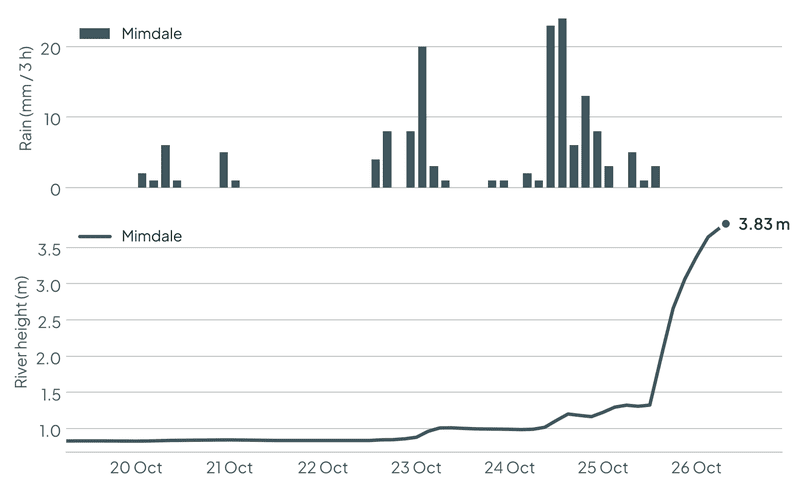
Baffle Creek is home to our newly found white-throated snapping turtle population, and right now it's the one to watch. Mimdale only got 12 mm on Sunday, but the creek shot up from 1.3 m on Sunday afternoon to 3.83 m by 7 am this morning, and it's still rising. That water is coming from further up the catchment. It's now about 2.8 m above its winter level, past the rough 20% nest inundation threshold. Another half a metre or so, to around 4.3 m, and most nests along that stretch could go under. We don't have a local nest-height curve for Baffle yet, so these numbers are borrowed from the Burnett. Getting that survey done is high on our list.
Mary River turtle (Mibir)
Mary River
Mary River turtles nest after rain. Just 10 mm over three days is enough to get the females up on the sandbanks. They got plenty this month, and 22–25 October brought 195 mm at Moy Pocket and 252 mm at Home Park. The trouble is what the river did next.
Up around Moy Pocket, rain kicked off nesting activity several times this month, starting in early to mid-October when the river was sitting around 0.7 m. On Friday and again on Sunday it peaked at about 4.5 m, a rise of around 3.8 m. In the lower Mary we know a 2.5 m rise inundates about 20% of nests. That figure comes from lower river banks so it's only a rough guide up here, but nests on low sandbars have likely gone under, maybe twice.
Uglier at Home Park. The river went from 1.3 m before the rain to 11.5 m on Sunday evening, a rise of about 10 m, and peak flow was around ten times the level where nests start flooding. A large proportion of October's nests on the lower Mary banks are very likely lost. It's still above 10.8 m this morning and only dropping slowly.
It's not over yet though. Females nest right through to December, so once the water drops and the banks are nice and damp, they can have another go. Floods like this can reshape sandbanks, though, and female turtles have walked away from some banks after big floods before, so we'll be checking our known sites. A nest laid in mid November would hatch around early January, right when summer storms can bring the next big rise.
That's it from me. A big thanks to our partners, landholders and everyone keeping an eye on the rivers. Please stay safe around flood water this week. And once things settle, if you spot turtles nesting on the Mary, we'd love to hear about it.
Tom
Data: Queensland Water Monitoring Information Portal, provisional readings to about 7:30 am, 26 October 2026.